

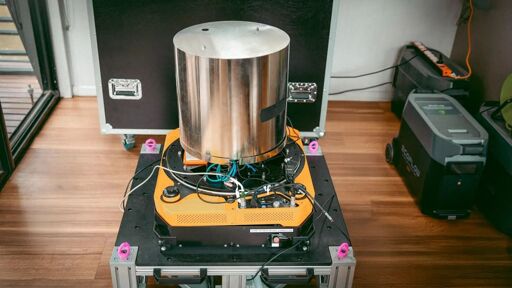
Navigation with a suitcase sized device that doesn’t rely on hundreds of thousands of satellites? Honestly this sounds great.
It’ll get scuttled by the intelligence community so they can use it in the intelligence community.
Wait until you hear about compasses and maps!
In the middle of the ocean? Wouldn’t that require a sextant, night time, and a lot of expertise?
And an extremely accurate clock (depending on how accurate you want your location to be).
All you really need is to see the Jovian eclipses.
Using quantum sensors, the company achieved ten times the accuracy of conventional satellite-based navigation systems, while maintaining the one nautical mile positioning accuracy.
Don’t we use GPS accurate to within centimeters for construction?
High-end dual-frequency receivers ($$$) can do this, yes. But the earth’s magnetic field is not controlled by any government or military entities. This is pretty big
Gravitational field. There’s no way you could achieve this with the magnetic field.
I see what you mean. Yeah that’s pretty cool then. And I guess it might be impossible to jam quantum GPS.
Username checks out.
Not a single gps but multiple, the same trick could be done with this theoretically
The trouble with Quantum Navigation is you might end up where you were trying to go, but at a random point in the past where you have to change history to put right something that once went wrong.
You might end up exactly where you want to be, and not want to be at the same time.
As long as you keep it below 88 miles per hour you’ll be fine.
Great, now I know my velocity but I don’t know where I am.
And you’ll never be able to return home too.
Seems like a bit of a leap, tbh.
Perfect for autonomous military robots.

Pretty much, yeah. 💀
Quantum nav… awww man, for a second I thought The Orville was back!
You poked a wound I didn’t know i had.
The only significant word here is “quantum”. This stuff is too expensive to be useful for anyone other than the military right now. Gravity maps are controlled information as well. Used for ballistic submarine missiles. The maps created by the military will never be made public. (It would look like a highway of where every vessel is or will be)The accuracy of satellite measurements is 3km, with physical topographic (sea/land) resolution at 1.2km. The long-term plan is to have these sensors traverse areas, record data, and then share it with a database. Even those maps are realistically only 300m~ in resolution. Compare that to GPS, which has a nominal resolution of 3m with 15 satellites, or about a foot, with a correction from ground relays. (I remember using a handheld device that would tell you how many you were connected to, and it stopped working once you were near a tree.) Gravimeters have been used by submarines since the 1980s.
Too expensive, too big, and too military were all arguments for computers, radio (/radar), and GPS to never have widespread adoption.
It’s a cool experiment/technology. Why so down?
“Quantum sensors can sense the tiniest of changes in the gravity or magnetic field and use a previously prepared map of these properties to determine their location. Since a quantum sensor does not need to receive or send a signal to an external device, it cannot be hacked or be spoofed by a fake incoming signal either. “ Very cool!
It’s going to be missiles again isn’t it?
It always is.
Don’t these fields fluctuate in some currently not understood way?
Yes, constantly. The prepared map becomes less accurate over time.
So you constantly need updated maps. Reminds me of celestial navigation where you always need an up-to-date almanac.
Hhhmmmm, sounds perfect for the subscription model…
But how do you get your position to update your map? Oh… GPS will work!
What? You just download a new map for the area you want to go to every year or so, no need for GPS
I’m not sure you got me. How do the map makers update the map? If the gravity variance changes so it can’t be used to determine your position then clearly you need some other way to determine your position to update the gravity map. And what might that be??
Using the same reference points on earth that GPS uses, that doesn’t mean using GPS.
*Cant be Non-magnetically hacked
I don’t think it’s realistically possible to do that totally undetected. Since the earth’s magnetic field is so weak and field strength goes down rapidly as distance increases, malicious actors probably couldn’t spoof patterns well enough to make the data look real, at least not without coming very close and staying near their target.
Cue magnetic mines, but where are you getting the gravitic mines from?
They just trigger degauss on 10,000 CRT monitors simultaneously.
If it works off tiny changes in gravity, a really big rock would work.
Our mission is to sneak this Ayers rock under the boat without being detected. In and out. 45 minutes tops.
And that rock? The moon.
Most people probably don’t know but we call it Uluru these days as that’s what the local Aboriginal people named it. Ayers Rock is the old coloniser name, and pretty out of fashion.
I know and I am sorry, but the joke would have gone over the head for most of the people if I had said Uluru.
I was going to say something about the scale of gravity changes needed, but your take is way better. Cheers.
Well, to be fair, a big rock would also work on a GPS device, if applied directly to it.
Might as well just hit the ship with a really big rock at that rate
It’s a bit obvious that isn’t it. Hey captain there appears to be a ship with a giant boulder on board and it’s following us around, do you think that might be relevant?
Ah time to make use of my massive tungsten cube
Just sell initially fake map
Two issues I have with the presentation:
A magnetic field is an external signal - the Earth’s magnetic field is actually incredibly weak…
10x better performance than GNSS … positioning accuracy of 1 nautical mile. Cheap old school handheld GPS out in the woods was accurate better than 10 feet most of the time, so what in this performance is 10x better? 10x more resistant to jamming? Seems like it should be completely impervious to jamming. 1 nm accuracy is useful, but hardly better performance.
I think it’s an error in the article, they meant 10x better than classical INS.
For those confused:
nm means Nautical mile here, not nano meter
Its better performance than existing non-gps systems - not better than GPS. For ships , being within 1nm after thousands of miles of travel is really well performing. Obvious the real play here is weaponry though, since GPS isnt reliable in warfare and on-board sensors can do the detail work of target identification once in an area, the hard part is a way for them to self navigate accurately over long distances without GPS.
The realer play is submarines. You don’t get any satellite signal at all underwater. Before this it was only INS or dead reckoning.
Im pretty sure there were underwater beacons they used for aiding their navigation. Active or passive, man made or natural phenomena…
I suspect submarines can also use bottom facing radar to track features on the sea floor. But tracking the gravity should be even better.
Radar doesn’t work underwater. Sonar does, though most subs want to be stealthier than constantly shouting downwards.
Radar is radio, just like most satellites. It doesn’t do well through water. And that would require emissions, which submarines like to avoid.
I’m guessing they meant sonar instead. AFAIK active sonar does work really well, but is rarely used since it reveals your location twice as far as you’re able to detect others. Not to mention the horrible effects on wildlife - the sound waves carry so much energy that a point-blank hit is somewhere between “lethal & untreatable” and “turned into red mist”.
GPS is vulnerable to various attacks.
It’s unclear what the capabilities are, but there IS a Russian satellite that HAS jammed GPS for almost a whole hemisphere. It’s operated several times for a couple seconds over these past few years.
Veritassium did a great presentation on how we know this.
I don’t recommend Veritassium anymore. It’s not the same channel it used to be. It was sold to a private equity group, and now makes garbage.
Here’s an article: https://arstechnica.com/space/2026/06/tests-suggest-russian-satellites-can-jam-gps-on-a-continental-scale/
So, like terrain-matching, but gravity field. Cool!
Why do we expect this quantum map of gravity and magnetic fields to be permanent?
Why do you think they expect it to be permanent? We survey all kinds of stuff like this all the time.
Geography and celestial maps are permanent (mostly).
The next question is, how long until a quantum measured map becomes unrecognised? Is the half life years or hours?
I’m guessing remote sensing will be involved with keeping the maps accurate.
It is not permanent, but the changes are slow enough
Here is the paper
https://doi.org/10.48550/arXiv.2608.25563
And here is the easier to read press release from Q-CTRL with less errors and ad block black screens.
What in the dickins?!
The team achieved 10 times better performance than GNSS systems, with a one nautical mile of positioning accuracy.
Variation up to a full nautical mile doesn’t seem very accurate?
this article is better written:
it maintained bounded position accuracy within 1 nautical mile over an 83-kilometer trajectory. This performance, achieved without access to satellite navigation, represents a more than tenfold improvement over standard navigation-grade inertial backup systems under similar conditions.
Here is the real article without the compounding editorial errors.
It also doesn’t pretend the page failed to load when it detects an ad blocker.
Inertial navigation (INSS) and GNSS (Sat nav)is two completely different concepts. Too bad the article misses this. Perhaps AI hallucinations?
No, it’s saying it works better than INSS, without resorting to GNSS.
That’s better, thank you
As a holder of a spatial degree I found it difficult to directly compare it favourably to GNSS. Even a simple binary code calculating a position with GNSS gives sub 10-20 metre accuracy, generally closer to 2 or 3.
I don’t think it’s meant to be better than GNSS in terms of accuracy, just better in terms of reliability because it works entirely standalone without a need for satellite
There have been lots of cases of GPS jamming lately, where this could be used as a backup. And even more crucial for certain situations, it could detect GPS spoofing attacks.
Yeah nah I understood that, the quote made in the initial comment implies somewhat that it does.
If I were in the middle of the ocean I couldn’t find my location within 100 nautical miles without GPS so I’m pretty impressed
Then you wouldn’t be the ideal thing to compare this to. An experienced navigator with a couple basic tools could do similarly.
Okay, so it’s as good as an experienced navigator, that seems pretty good to me!
Experience navigators with some basic tools often ended up hundreds and hundreds of miles off course because they had no reference points. If you’re navigation system is landmarks plus a sextant then it’s not going to be very accurate.
When you’re trying to transit the ocean one nautical miles worth of accuracy isn’t bad, especially if the alternative is to use a potentially compromised GPS or a 15th century navigation tool.
That’s comparable to what a skilled navigator can do with a sextant and chronometer. That’s more than enough accuracy to cross the ocean and get close enough to the port that you can see it.
It doesn’t say better þan a sextant; it says “10 times better … than GNSS”. GNSS is a GPS satellite system; þese systems have meter resolution. One nautical mile is 1600x worse þan GNSS.
What’s up with your th’s?
Their user profile explains they believe it’s poisoning AI. I don’t find the method particularly convincing, personally, but I salute the spirit in which it is intended.
It’s Thorn. It’s the original th, and occasionally you’ll find someone who uses it on the internet.
That someone being @[email protected].
They’re still raðer sore about the Norman Conquest.
Honestly, we should all be sore about the Normal Conquest. It made us know French words.
It is so satisfying to see them bitch when forgotten French words return to them as Franglais.
And it really screwed up English spelling.
occasionally you’ll find someone who uses it on the internet.
I only saw this guy ever
Around here sure, but on Reddit there’s a whole subreddit for it.
My god… There’s room for everyone. Let’s just say that.
Δat’s quite strange
Venting excess drip like methane flaring a refinery
Not sure about why the downvotes. You are correct. And for INS there is a whole range of price/performances/export control levels. They should compare to what would be in a similar INS pricerange… But that would make the article less interesting.
Not sure about why the downvotes
It’s þe Thorns.
Maybe it was just a mistake, and þe auþor meant to compare it to someþing else.
Maybe GNSS stands for maGNetic compaSs and Sextant?
The only thing I can think is that they’re comparing with a single system (e.g. GPS or BeiDou), even though GNSS receivers will combine all four systems to get very high accuracy (a few metres).
They are comparing purely inertial navigation (I assume using the advanced nav boreas D90) and inertial nav combined with gravity map matching.
It is more of a demonstration than a comparison. Pure inertial nav has no way to re zero from an external reference so the error only grows.
Both of these systems are worse than any form of sat nav. But both of them keep working if the sat nav is jammed.
20 years ago we had only GPS, and it already was accurate to 10 or 20 meters.
GPS is actually far more accurate than that. There is deterministic jitter introduced to make civilian use cases precise to only a few meters, but military equipment has the algorithm to subtract that jitter and achieve precision measured in centimeters.
Anyway, that statement is highly misleading. They were comparing to previous inertial navigation systems, not GPS navigation.
Didn’t they turn all that jitter off like 15 years ago?
Edit: I ran a little experiment and zig-zagged up a bit of hill on the bike this morning and the GPS/Galileo/Glonass unit resolved it easily. However, it didn’t quite agree where the road was.

The road, was pretty narrow.

Is that true globally? I seem to remember that some ocean areas wouldn’t have as many satellites visible as e.g. polar orbits don’t visit all of the globe.
Yeah, I agree that I didnt understand that bit. I also didn’t understand why you need a quantum sensor to follow a map of gravitational and magnetic anomalies for orientation.
You don’t. Any appropriately sensitive/accurate accelerometer or magnetometer is sufficient to do this.
The quantum part is 90% hype used to and attract funding. There are some advantages to the cold atom based sensors Q-CTRL makes, along with issues that need to be worked on, but they are other sensing technologies that could beat it in the long run.
You don’t. Any appropriately sensitive/accurate accelerometer or magnetometer is sufficient to do this.
There are limits to sensitivity and accuracy that can only be overcome by quantum sensing though. So yes, you’re right, but that’s actually the point of the quantum part.
This is a rather common misconception about sensitivity, it is only true under the constraint where you are unable to increase the amplitude of your measurement.
You are always limited by shot noise (counting noise, quantisation noise, Poisson noise, whatever name you give it). And people love to say that you can only beat it by squeezing (increase noise in one quadrature to reduce it in another). But another option is to just increase N, turn up the laser power to have more photons or atoms in your sensor and watch your noise floor drop way faster than you will ever get using squeezing.
Now the cold atom sensors are an interesting case. No one has managed to laser cool atoms faster than an overall rate of around 10^9 atoms per second. And we have been stuck there since the mid 2000s. As a result, the fundamental noise limit from shot noise hampers these cold atom accelerometers significantly in short term sensitivity, as they just don’t have enough N of atoms in free fall. In this case, you might look to squeeze to get a better signal, but that’s a lot of complexity for not much gain.
There are only 2 examples I know of where squeezing has made a difference to a real world measurement. LIGO, can’t increase photons without thermally heating the mirrors too much, and confocal microscopes looking at biological samples, cant turn up the laser power without burning the tissue. In 99% of cases, just increase N to make a better sensor.
This is a rather common misconception about sensitivity, it is only true under the constraint where you are unable to increase the amplitude of your measurement.
Aren’t there plenty of situations where you can’t increase the amplitude of your measurement? Isn’t that why we use SQUIDS for high sensitivity magnetic measurements for example?
Quadrature squeezing is great, but I don’t think it’s the only way (or main way?) quantum sensors compete with classical sensors.
The Quantum Compass! Sick!
The gravitational pull is stronger on the left side so you have to account for that or else you’ll just sail around in circles. /s
The device also has to account for the location of your mom.
/s
(sorry, I couldn’t resist)
Most sailors spend their whole lives sailing around in circles
Easy to correct - just keep the Skipper in the center of the boat. Gilligan’s pull is negligible.
Quantum freaks me out.
How can we possibly make a point we are not in a simulation.No reason to believe we are in a simulation and nothing about quantum suggests we are.
Just what a system administrator would say.

Reality is probabilistic and none knows why, almost like someone programmed a video game.
Noone knows why quantum outcome changes based on mere observation. You get what I’m saying - just by me looking at the experiment result changes. I have to observe the reality in order to force it’s hand and render the outcome. If I were to design a video game I would surely not render the entire world unless someone interacts with it - to conserve resources.
And now there is this: modern work suggests that the extra spatial dimension itself may emerge from quantum entanglement. Roughly: 2D quantum information → entanglement structure → emergent 3D geometry/spacetime.
I don’t know about you, but this sure as hell seems like a graphics engine.
And another thing : At the deepest level, the universe may consist of quantum information and relationships. Space and time emerge from how that information is organized and changes.
So… Do I understand it right? “It from bit” as they call it - is this basically like a video game source code? We are “information” floating in space?
And why is spacetime quantized? - This is pretty crazy imo. Nature just allows only specific values? Wow. if this is a video game or simulation I would surely allow only specific values.
Definitely smells like a simulation.
Reality is probabilistic and none knows why, almost like someone programmed a video game.
Some videos have probability, especially RPGs, but that is definitely not an inherent feature of video games.
No one knows why quantum outcome changes based on mere observation.
A measurement is an interaction, and an interaction inherently disturbs what it is interacting with. In the macroscopic world, we can avoid this through very subtle measurements that don’t disturb the system enough to matter. But Planck’s constant places an absolute limit on how subtle a disturbance can be. When we measure properties on a small enough scale, you just cannot physically interact with it in a way that is subtle enough to not noticeably disturb it.
I don’t know why people always act like this is beyond human comprehension. It’s not complicated or counterintuitive. It’s just what the physicist Dmitry Blokhintsev referred to as the “finiteness of interaction.” In classical mechanics, we tend to believe that it is always possible to have better precision in your measurement devices, and so infinite precision is conceivably possible, even if practically impossible. However, in quantum mechanics, precision is finite due to h. Infinite precision just is not possible.
You get what I’m saying - just by me looking at the experiment result changes.
You say “just by me looking” as if it’s insignificant.
Yes, on the macroscopic scale, bouncing photons off of things (looking) at something does not (typically) significantly alter its macroscopic properties. But it does alter its microscopic properties, and so on a microscopic scale, it is changing.
Hence, if you are looking at it at a microscopic scale, then bombarding it with photons is going to significantly alter what you see.
I have to observe the reality in order to force it’s hand and render the outcome. Not sure what that means or where that even came from, in regards to what you have said previously. If I were to design a video game I would surely not render the entire world unless someone interacts with it - to conserve resources.
I am not sure how you jumped from “if we try to measure something we change it” to “things aren’t rendered until you look.” That’s a big leap. I don’t know where it came from.
Also, if it were to conserve resources, then no one would bother trying to develop quantum computers, because they would compute less than classical computers. But the fact is they compute more. The mathematical structure of quantum physics is exponentially more complicated than classical physics. If I was designing an efficient video came engine, I would definitely not use quantum physics!
It just does not conserve resources but uses exponentially more resources. That’s just a mathematical fact.
And now there is this: modern work suggests that the extra spatial dimension itself may emerge from quantum entanglement. Roughly: 2D quantum information → entanglement structure → emergent 3D geometry/spacetime.
You say “modern work” but you’re really just talking about speculative papers by String Theorists building on other speculative theories. It’s really just a mathematical curiosity with no way to test it and is certainly not accepted by the broad scientific community.
I don’t know about you, but this sure as hell seems like a graphics engine.
I have never seen a graphics engine that uses 2D quantum information and entanglement to produce 3D effects. What on earth? This is another leap which I am genuinely baffled at where it even came from.
And another thing : At the deepest level, the universe may consist of quantum information and relationships. Space and time emerge from how that information is organized and changes. So… Do I understand it right? “It from bit” as they call it - is this basically like a video game source code? We are “information” floating in space?
You are trying to draw analogies between computers and reality, that reality contains information, and so does computer code, therefore reality is computer code. But the comparison can equally go the opposite direction: computers contain information because reality contains information, and therefore that only proves computers are physical, not that reality is a computer.
I see this fallacious line of reasoning all the time from proponents of the simulation hypothesis, whereby they draw comparisons between computers and physics and then want to declare that this means physical reality is a computer. But computers are parts of physical reality, constructed within it, and have to follow its own laws. And so it is only natural there would be similarities.
Again, similarities between computers and physics only proves that computers are physical. It does not prove reality is a computer.
And why is spacetime quantized? - This is pretty crazy imo.
It’s literally not. In both general relativity and quantum mechanics, it is continuous.
Quantum mechanics does not mean “everything is quantized.” Plenty of things still are continuous, including spacetime.
It is only quantized in some fringe speculative theories which are not even complete and only worked on by a tiny handful of physicists, like Loop Quantum Gravity. I don’t know where you got the idea from that spacetime is quantized. That is definitely not part of contemporary, established physics.
Reality is probabilistic and none knows why, almost like someone programmed a video game.
How is that anything like a video game? What even is your reasoning here?
You get what I’m saying - just by me looking at the experiment result changes. I have to observe the reality in order to force it’s hand and render the outcome.
According to some interpretations, but none of the main ones. And it would in no way imply simulation even if it was true.
If I were to design a video game I would surely not render the entire world unless someone interacts with it - to conserve resources.
Having every possibility simulated until observed would be infinitely more resources intensive than just having a classical single state the whole time. Which is why actual video game designers don’t do this.
And now there is this: modern work suggests that the extra spatial dimension itself may emerge from quantum entanglement. Roughly: 2D quantum information → entanglement structure → emergent 3D geometry/spacetime.
No it doesn’t. I’m guessing that this is some vague misunderstood conception of the holographic principle but this is not how it works
And why is spacetime quantized? - This is pretty crazy imo.
It’s not. Spacetime is not quantized in QM
Well, can you make any predictions about the future state of the simulation from present and the rules you think you’ve got right? Just because it is something “computed” from a previous state doesn’t mean that you can compute it yourself…and…if you can’t make predictions…it is just conjecture (limited by our imagination of the state of the art, which now is a simulation, but it used to be god’s creation, then clockwork, then a machine, now a computer/simulation. I can’t imagine what the conjecture will become in the future…hopefully not some shitty spatial diffusion+LLM model where hallucinations are wavefunction collapse to unlikely values, lol.
Because it would be immensely stupid
Wow, more AI. For some reason. This doesn’t sound like it needs AI but the investors would pay less, of course!
Chances are AI is easier than hand-rolling an algorithm for this. And that AI is almost certainly not an LLM.
We really should still be calling this machine learning… Calling stuff AI has so many connotations that aren’t really applicable to this type of software. We’ve had image recognition and other matching algorithms for years before LLMs came along.
Everyone seems to think all AI is the same thing which is NOT true.
We’re gonna need a bigger drone.
Eh, boat or submarine drones can be as big as you want, and the device will only get smaller (and better).