You must log in or # to comment.
Forgive me because I’m not super familiar but like how would you prove someone is using a VPN? Like isn’t the whole idea that it masks where the user is actually from?
I’m afraid this makes me sound like an idiot but I’m genuinely curious
Outside of specific implementations like Tor’s snowflake protocol, it’s very easy for internet providers to see who’s using a VPN, the only thing it buys you is privacy at the other end (so they’ll know you’re using a VPN, just not know what you’re using the VPN to look at, hence why their panties are in a twist).
Other user answered the question accurately. I just wanted to say that asking doesn’t make you sound like an idiot. VPN companies intentionally market their products with the purpose of making people believe that they are some magic and untraceable secure system.
the way vpns are used now is not what they were designed for, and they are sold to layman users with promises they can’t fullfil.
vpn is virtual private network, and what is does is establishing encrypted connection between two vpn points.
(home network) --- (vpn server) ----- (unsecure internet) ----- (you)
     (A) -------------- (B) ------------ (x) ----- (x) --------- (C)
you can now connect to your home network (which may be your company when you are on home office, or it may be your department of foreign affairs if you are your country’s embassy halfway around the world) using the vpn server, who authenticates you as a user and establishes encrypted connection to traverse the unsecure network.
it increases security in two main ways: the admin of the networks does not have to accept incoming connections from the whole internet, which reduces number of ways to attack the network.
the traffic going over the public internet and servers you have no control over is now encrypted and can`t be hijacked in the middle.
and it hides the route and traffic between
(B)and(C). for everyone in(A), your traffic seems to look coming from(B), they don`t know what is behind it.now using some public vpn service may help you pretend you are in another country (because the provider will provide you with server in that country, and no one sees the route between you and the server.
so you can now convince twitter you are black soccer mom in texas supporting trump, when you are actually gru officer in moscow.
but it is oversold to people as some super secure solution and people think it is more secure than it is. your traffic can no longer be intercepted between you and the vpn server, but can be intercepted anywhere behind it.
if you think you are some enemy of the state, it is actually much less secure. “the enemy” now have limited number of chokepoints where they can try to intercept the traffic, and doesn’t have to intercept all its little enemies independently. it is like if people voluntarily joined the line for some police checkpoint.
there are even conspiracy theories that some vpn providers and tor nodes may be directly operated by “the enemy” instead and if your data are really valuable (you are not a teenager trying to get to netflix, but you are say disident or journalist in some dictatorship country) then using tor, or vpn generally, may put target on your back - hey, these are data that are more likely to contain something interesting and may be worth monitoring.
long story short, vpn is designed to traverse unsecure public internet and connect you to some trusted network. the connection is allowed only to identified users and is encrypted and secure.
using it to connect to unsecure internet helps you
- get access to netflix show that may not be accesible in your location
- may help hide your identity (if the vpn server is in different jurisdiction, it can be complicated for law enforcement to get information)
- may be useful if you think your own internet provider is after you and you trust the vpn provider more (which is definitely not the case for me in europe, i trust my own isp more than some random vpn provider, someone in iran may be in different situation)
- anyone intercepting the traffic in your home provider’s network can see there is a connection between you and the vpn server, but can’t see the content, and can’t easily establish connection between you and outgoing data from the vpn server you are connected to.
and to asnwer your original question, if you operate your own vpn server at the remote location, no one will know. but if you use some public service for 5$/month, these and their servers are of course known.
It’s like an internet glory hole. It stops the people monitoring your broadband from seeing exactly where you’re browsing and what you’re viewing, and it stops the people who run those websites from seeing exactly who you are.
But it’s entirely possible for your broadband provider to see that you’re standing at a glory hole with your junk out. And the people serving you the website can also see your junk through the hole.
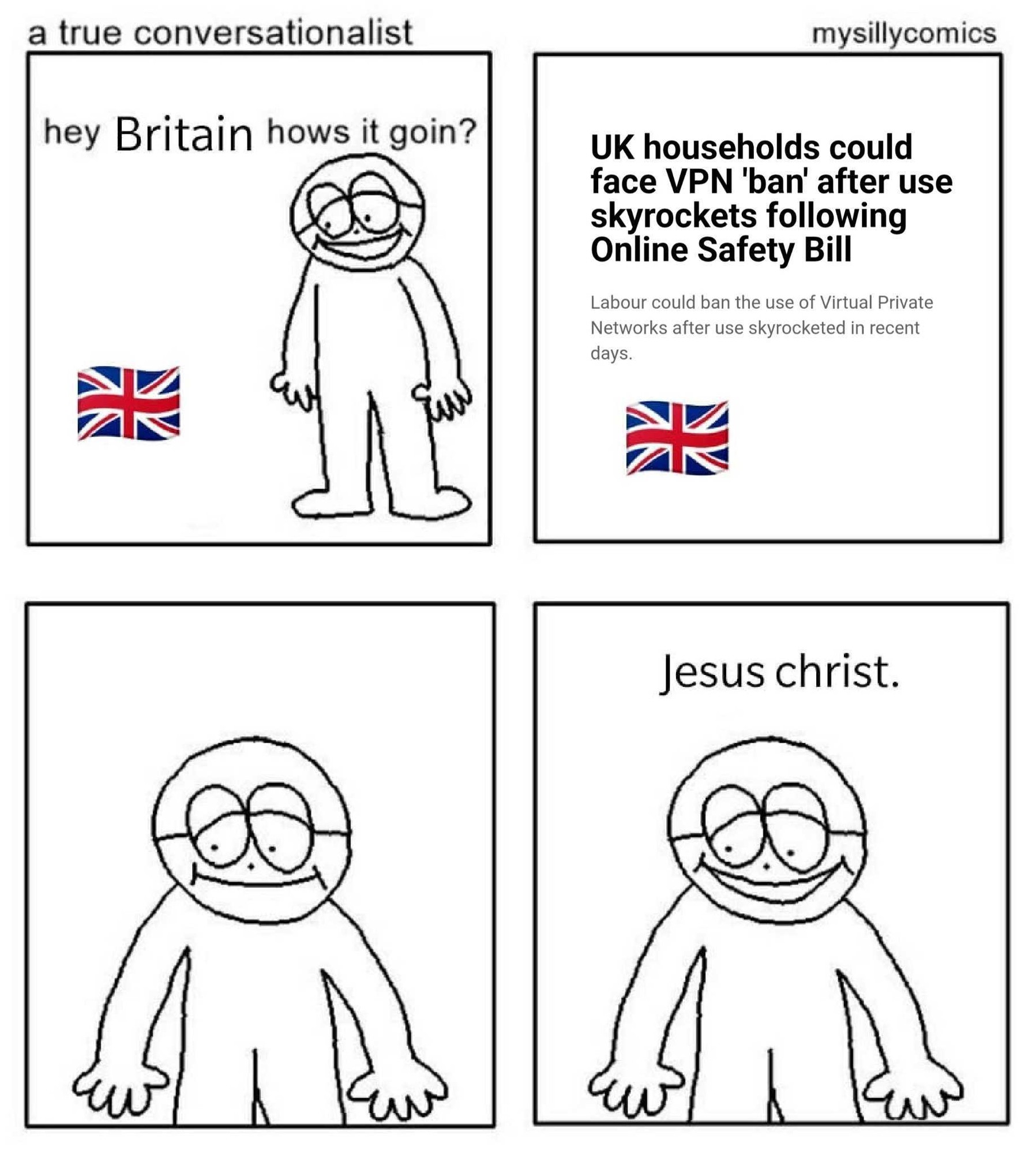
This isn’t a UK thing, it’s the entire developed world.
Multiple US states are considering it. Chat control in the EU is still a possibility. China and Russia already put efforts in restricting access.
Those in power are always trying to find a way to screw us over.
I miss when no politicians even understood what the internet was.
They still don’t, they’re just more embarrassed about it now that almost everyone else does.
Which leads to more overcompensating and thus stricter controls.
No I think it’s much worse. They are thinking of adding an app on your device that’ll constantly monitor all media to see if it is CSAM and report to police
Jesus…
Jaysus
Labour have completed Blair’s project and become the quintessential centrist libfash party.
All y’all Americans who like Buttegieg or Newsom, this is what you’re trying to get for yourselves.
Newsom sucks, but California doesn’t have laws like this.
Corporate Office owners overjoyed.
Maybe its skyrocketed because the misnamed “online safety act” does nothing useful and just gets in the way of people trying to use the internet!
there’s no way that could backfire spectacularly
Wow just like China nice UK
Y’all it is not a coincidence that these authoritarian tactics are applied after years of successful resistance against genocide in Palestine. The U.K. is one of the only countries in the world where a Zionist arms supplier, Elbit, was forced to close a facility due to repeated direct action interference in operations. They are terrified that the internet is more resilient to conventional means of propaganda than what other forms of media are; which liberals have already spent a century trying to get under control. Combined with a perceived increased threat to “democracy” by Russian social media disinformation campaigns – which are somehow undesirable yet consistent with capitalistic imperatives – liberals are terrified of the internet’s ability to challenge their rule.