
PugJesus
History Major. Cripple. Vaguely Left-Wing. In pain and constantly irritable.
- 213 Posts
- 117 Comments
Joined 11 months ago
Cake day: March 24th, 2025
You are not logged in. If you use a Fediverse account that is able to follow users, you can follow this user.
 6·6 days ago
“Boromir would have brought more oil”
“One does not simply walk into Mordor.” - Boromir
Frodo and Sam at the Black Gates, ready to just walk into Mordor before Gollum stops them:
Saruman: “I take full responsibility for this but I have no clue how it happened”
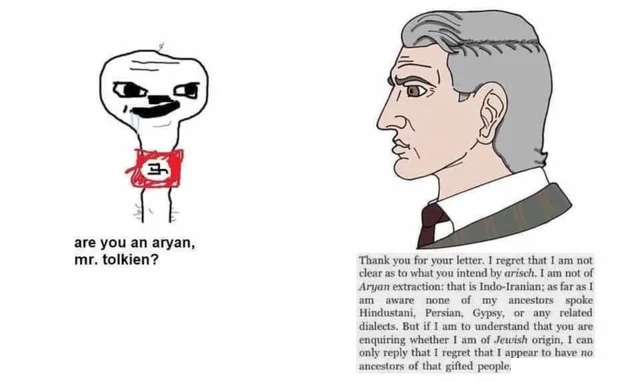
Explanation: Shortly before WW2, a German publisher contacted Tolkien and expressed interest in translating The Hobbit into German. However, they also attempted to verify his “Aryan” descent, so as to suit Nazi Germany’s norms for authors.
He drafted a reply as folllows:
Dear Sirs,
Thank you for your letter. I regret that I am not clear as to what you intend by arisch. I am not of Aryan extraction: that is Indo-Iranian; as far as I am aware none of my ancestors spoke Hindustani, Persian, Gypsy, or any related dialects. But if I am to understand that you are enquiring whether I am of Jewish origin, I can only reply that I regret that I appear to have no ancestors of that gifted people. My great-great-grandfather came to England in the eighteenth century from Germany: the main part of my descent is therefore purely English, and I am an English subject — which should be sufficient. I have been accustomed, nonetheless, to regard my German name with pride, and continued to do so throughout the period of the late regrettable war, in which I served in the English army. I cannot, however, forbear to comment that if impertinent and irrelevant inquiries of this sort are to become the rule in matters of literature, then the time is not far distant when a German name will no longer be a source of pride.
Your enquiry is doubtless made in order to comply with the laws of your own country, but that this should be held to apply to the subjects of another state would be improper, even if it had (as it has not) any bearing whatsoever on the merits of my work or its sustainability for publication, of which you appear to have satisfied yourselves without reference to my Abstammung.
I trust you will find this reply satisfactory, and
remain yours faithfully,
J. R. R. Tolkien
Explanation: Gaius Aelius Gallus was a commander under the first Roman Emperor, Augustus. Gallus was ordered to undertake an expedition to conquer Arabia with 10,000 troops, including local allies - a relatively small army. If successful, it would have massively increased the tax revenues of Rome, as the Arabian states controlled the flow of spices and silk and other exotic imports from the east.
Despite considerable military success in open battle against the Arabian polities, the Romans were chipped away at by the unrelenting desert itself - stretched supply lines, enemy raiders, unfamiliar environs, heat, exhaustion, and sickness took their toll. Eventually, Gallus withdrew from the region, making a two-month retreat from modern-day Yemen back to Roman-controlled Egypt, having lost a majority of the expeditionary force in the process - many of them during the retreat itself.
… you’re welcome, I suppose?
Trauma paralyzes, nostalgia gets you going.
… if you’ll excuse me, I have a lot of memories I need to re-evaluate

I TOLD YOU TO TAKE THE WIZARD’S STAFF
 10·21 days ago
Honestly? I’m ready to let them have a shot at it. We ain’t done so hot, what’s the worst that could happen?
Title Explanation: Germany has a history of naming its tanks after ‘big cats’. Panther, Tiger, Leopard, etc. This here’s a little cat tank.
It’s my favorite by a fair margin. It’s so atmospheric.
Heresy warning: I don’t have this reaction with Return of the King. Not that it’s not still great or is lacking in good moments, but it’s not packed to the brim of favorite moments the way Fellowship and Two Towers are.
Exact casting negotiable
gettin’ the good succ
Me, gentle caressing my 2 decade year old DVD case (the disc is so scratched it no longer plays all the way through)
 3·28 days ago
Somehow, the Confederacy returned
Wage labor, usually.
Despite the widespread use of slave labor in Roman society, unskilled slaves were overwhelmingly used for tasks that were either considered ‘demeaning’ (like domestic servants), did not require any real precision (like mill grinding and monocrop farm labor) or needed a constant application of labor (like mines). The Romans recognized that people work better when offered carrots rather than sticks - some slave who only barely cares if he lives or dies isn’t going to put much effort into aligning the brick with the mortar properly unless you watch him like a hawk - which is more labor you have to put in. Manual labor for construction is not a task that requires a doctorate, but it is a task where you have to do it right the first time, or you waste everyone’s labor and effort.
Construction, furthermore, is only intermittent work in most places. If you own a bunch of slaves, you don’t stop paying for their food and shelter when they aren’t working - if you want them to be profitable, you’ll have to find other work for them to do the rest of the year. And at that point, it’s probably not less profitable to just have them do that year-round instead. You could, potentially, have your slaves as a traveling construction crew, but travel is not only uncertain and expensive, but offers opportunities for unmotivated workers (like slaves) to simply… slip away, and choose to no longer be one of your workers. Even if you try to hunt them down. Even just transporting building materials from Point A to Point B includes a lot of very dangerous unsupervised time - perhaps something you’d trust a household slave with, but not one of the faceless slave numbers on your business ledger!
Funny enough, it would be more likely, if anyone was a slave on the job, that it would be potentially a few of the skilled positions. Skilled slaves were often given more trust and responsibilities precisely because they were offered more ‘carrot’ than ‘stick’ - payment, privileges, and the possibility of freedom for a decade or two of labor were on the table. Skilled slaves were thus less likely to run away - and unlike free wage laborers, especially skilled ones, wouldn’t (or rather, couldn’t) demand more pay at the prospect of being dragged from one of the empire to another - very handy if you’re a small construction firm going from place to place, and hiring local labor for most tasks!

















Apparently…