Has the same vibes as anthropic creating a C compiler which passes 99% of compiler tests.
That last percent is really important. At least that last percent are some really specific edge cases right?
Description:
When compiling the following code with CCC using -std=c23:bool is_even(int number) { return number % 2 == 0; }the compiler fails to compile due to
bool,true, andfalsebeing unrecognized. The same code compiles correctly with GCC and Clang in C23 mode.Well fuck.
If this wasn’t 100% vibe coded, it would be pretty cool.
A c compiler written in rust, with a lot of basics supported, an automated test suite that compiles well known c projects. Sounds like a fun project or academic work.
The incredible thing is this is actually the result of an explicit design decision.
The compiler accepts most GCC flags. Unrecognized flags (e.g., architecture- specific -m flags, unknown -f flags) are silently ignored so ccc can serve as a drop-in GCC replacement in build systems.
They’re so committed to vibing that they’d prefer if the compiler just does random shit to make it easier to shove it haphazardly into a build pipeline.
any llm must have several C compilers in its training data, so it would be a reasonably competent almost-clone of gcc/clang/msvc anyway, right?
is what i would have said if you didn’t put that last part
This is so fucked up. The AI company has the perfect answer and yet it rolls the die to recreate the same thing by chance. What are they expecting, really?
The error is ~1/log(x), for anyone interested.
LLMs belong to the same category. Seemingly right, but not really right.
l/whoosh
you can increase its accuracy by changing the parameter type to long
I have seen that algorithm before. It’s also the implementation of an is_gay(Image i) algorithm with around 90% accuracy.
If you think this is bad and not nearly enough accuracy to be called correct, AI is much worse than this.
It’s not just wrong a lot of times or hallucinates but you can’t pinpoint why or how it produces the result and if you keep putting the same data in, the output may still vary.
It has actually 100% accuracy
95% of the time
Can we just call the algorithm sex panther and move on?
Reminds me of this xkcd:
also sort of https://xkcd.com/2934/
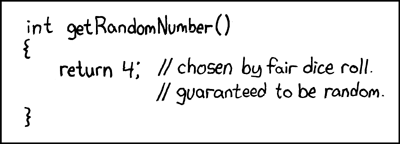
info
View the source to see how I embedded the picture without copying it. The hover text had to be copied though.
More like: https://xkcd.com/2236/
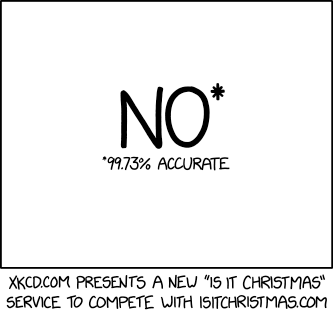
info
View the source to see how I embedded the picture without copying it. The hover text had to be copied though.
My favorite part of this is that they test it up to 99999 and we see that it fails for 99991, so that means somewhere in the test they actually implemented a properly working function.
No, it’s always guessing false and 99991 is prime so it isn’t right. This isn’t the output of the program but the output of the program compared with a better (but probably not faster) isprime program
Yes, that’s what I said. They wrote another test program, with a correct implementation of IsPrime in order to test to make sure the pictured one produced the expected output.
Plot twist: the test just checks to see if the input exists in a hardcoded list of all prime numbers under 100000.
I mean people underestimate how usefull lookup tables are. A lookup table of primes for example is basically always just better except the one case where you are searching for primes which is more maths than computer programming anyways. The modern way is to abstract and reimplement everything when there are much cheaper and easier ways of doing it.
I’m struggling to follow the code here. I’m guessing it’s C++ (which I’m very unfamiliar with)
bool is_prime(int x) {
    return false;
}
Wouldn’t this just always return false regardless of x (which I presume is half the joke)? Why is it that when it’s tested up to 99999, it has a roughly 95% success rate then?
That’s the joke. Stochastic means probabilistic. And this “algorithm” gives the correct answer for the vast majority of inputs
I suppose because about 5% of numbers are actually prime numbers, so false is not the output an algorithm checking for prime numbers should return
Oh I’m with you, the tests are precalculated and expect a true to return on something like 99991, this function as expected returns false, which throws the test into a fail.
Thank you for that explanation
If you scaled it based on the size of the integer you could get that up to 99.9% test accuracy. Like if it’s less than 10 give it 50% odds of returning false, if it’s under 50 give it 10% odds, otherwise return false.
That would make it less accurate. It’s much more likely to return true on not a prime than a prime
Code proof or it didn’t happen.
Extra credit for doing it in Ruby
Correct. Not are why people are upvoting. If 10% of numbers are prime in a range, and you always guess false, you get 90% right. If you randomly guess true 10% of the time, you get ~80% right.
More random means more towards 50% correctness.
And 2,3,5,7 are primes of the first numbers, making always false 60% correct and random chance 50%
100% of the time, baby =)
I mean, an application could exist where this isn’t even wrong. Maybe as a “subroutine” of another algorithm that only needs a truly composite number most of the time to work.
That this reads as a joke says a lot about what application we’re intuitively expecting.
Edit: Not sure why this is being downvoted.
Edit: Not sure why this is being downvoted.
Perhaps because it would do better, being replaced with
noop.A link time optimiser might actually do so.
That’s kind of what I meant by putting “subroutine” in quotes. You obviously wouldn’t write it like this, you’d just use a random large number with a bit of explanation.
Oh well, live and learn. I’ll try to be clearer next time.
I just took the above comment as continuing the joke, but this explanation actually confuses me more.
Well, I don’t really think you need to be very clear in this case. Jokes are more fun when you “get” them rather than have them explained.I get OP was a joke, but I was trying to make a serious observation.
Say you have some kind of stochastic algorithm that works on the assumption it’s fed a composite number most of the time. Maybe something like Pollard’s Rho algorithm, where whatever number theoretic structure you need accumulates slowly over time as a result. You decide to just pick a large number at random for each iteration.
Implicitly, you’ve solved the problem of finding a composite number by assuming all (large) numbers are composite, like in this post. It is pretty close, like also mentioned in this post. If that’s not good enough, you could also use a primality test that fails some small portion of the time, which do exist, and use less power than guaranteed tests.
I see. So the reason I didn’t get it was because you were not really joking. Also, I seem to not have much background information of the domain you are talking in, so can’t continue thee conversation in my current condition.
Alright. Thanks for responding, anyway.