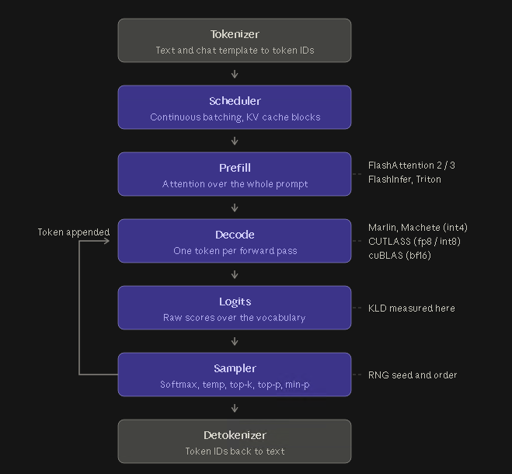
Quick Introduction We have all been on forums, chats, reddit, discord, youtube, or somewhere and heard “Oh! Model XYZ is AMAZEBALLZ!zomgwtfbbq” then downloaded it (or more likely, some quantized form of it) and said “eww… This sucks!” This post is going to be a rather technical series of experiments to demonstrate the impact of implementation-specific hazards with inference. I will be using the term “reference implementation” to describe the lab that published and offers first-party hosting of ...


The fact they are trained to complete sentences and are thus word predicting models only tells us vaguely how they work. It does not tell us anything about their sentience.
The sentience, if there is, comes from the emergent reasoning that develops in the massive neural network to offer actual good predictions: the more you think, the better the predictions.
For example, models trained to produce textual board games predictions can be sounded to show they developed subnetworks corresponding to an inner representation of the states of the game. Models trained to produce images have emergent subnetworks on depth-maps, contours and lighting.
Are cells sentient? Bacteria, fungi, etc. Do you think they have any degree of interiority, like how simple animals do?
Exactly. It’s not so cut and dry. Are they? You can never know until you experience their existence.
Lol no. Actually cells are demonstrably NOT sentient. They have no capacity for choice. No capacity for emotion or experience. They are literally molecular machinery. And we(scientists) understand that machinery to a shocking degree.
If you think cells have any degree of sentience, then you must make a similar argument for advanced clockwork machines. Not robots, pure wind-up clockwork automata.
Ah, so you’ve experienced each of their existences? Fascinating.
Please explain to me how a wristwatch is sentient or conscious.
I can’t, since I’ve never been a wristwatch. Maybe they’re not, or maybe they are through a mechanism for which science has no current explanation. We can’t know, only surmise.
Okay, then you’re not actually engaging in any degree of coherence. Your ignorance is not wisdom, despite what you seem to have convinced yourself.
That’s some impressive hubris you’ve got.
So tell me, in your infinite wisdom, from where does sentience arise and what is the smallest organism that is sentient?