deleted by creator
The advantage of that last approach is that it has side effects and cannot therefore be optimized out by the compiler.
That’s only one advantage. In theory it does not necessarily terminate, so that’s another one.
In
theoryhypothesisTo get pedantic, you’d have to test that out a whole bunch before even coming close to theory level, lol!
We already have a theory for it— called computer science.
function myFunction() {
  try {
    x = new Random().nextInt();
    if (x != 10) {
     throw "not 10";
    }
    else {
      return (10)
    }
    catch(err) {
      myFunction()
    }
  }
}

x = myFunction()
Commit notes: Added error handling
Returning 10 instead of x when x finally ends up being 10 really ties it together.
I’m glad you noticed. That was my favorite part too.
SyntaxError: Unexpected token ‘catch’
Coding on mobile is hard
That’s not even enough to get you a job these days.
You now have to use:do { x = reinterpret_cast<int>(AI::Instance().ask("Do Something. Anything. Be efficient and productive. Use 10 tokens.")); } while (x != 10);For a time on Reddit (some years ago when I still used it) there was a trend of finding the worst way of implementing
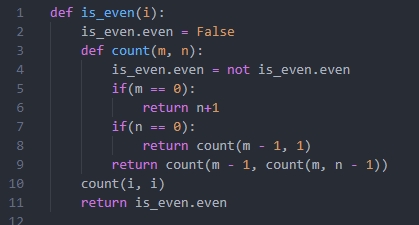
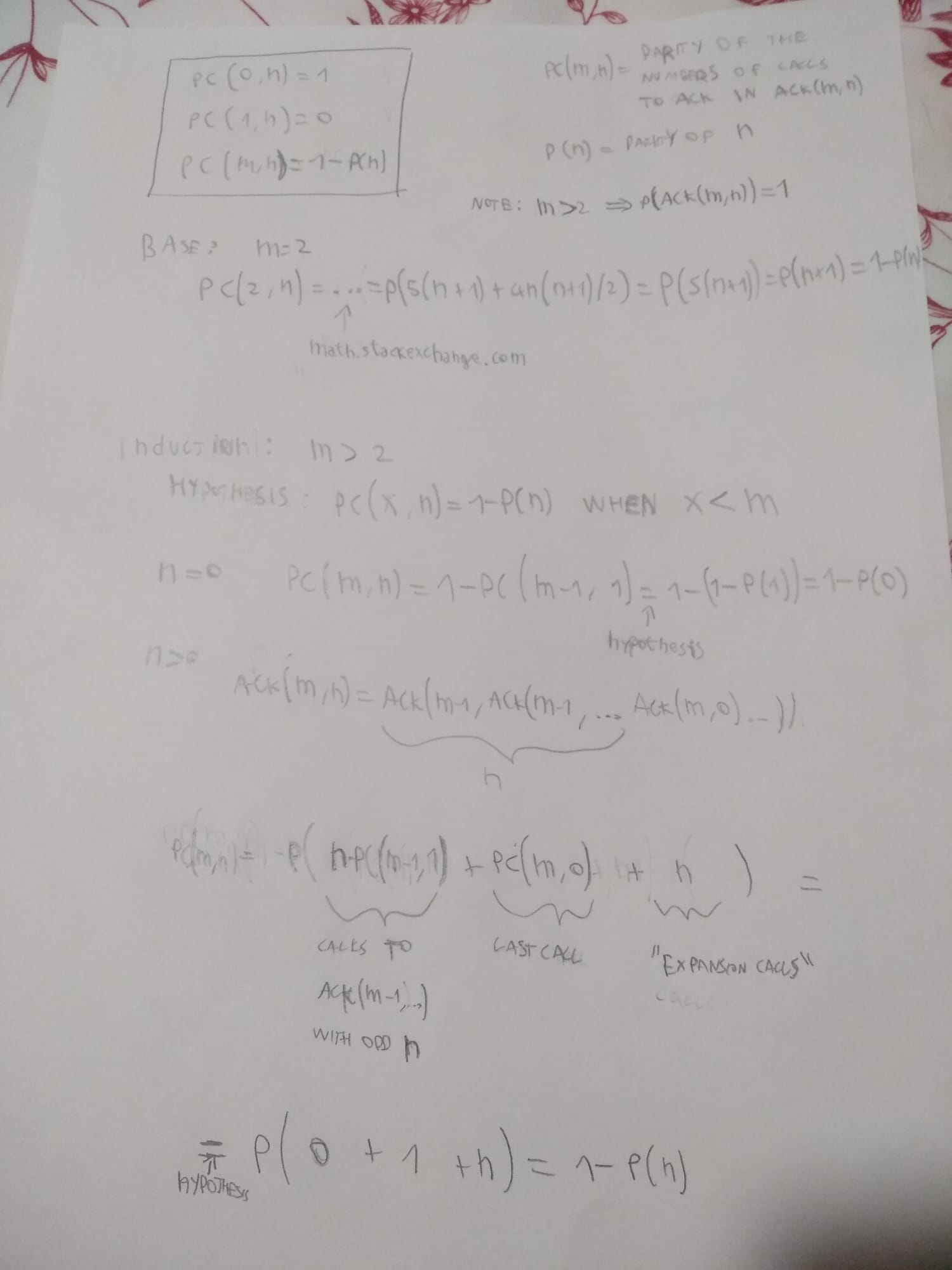
is_even(x: int) -> bool. My contribution to that was a function that ranAckerman(x,x)flipping a Boolean at every iteration, and check if it was true or false at the end.It works btw, I will find the proof later
I would love to see the implementaion.
The implementation is not very exciting, I capture a variable in python. It could have been done more cleanly.
The proof is this. But, I could have made mistakes, it was many years ago.
Note that in python you’ll never be able to run
is_even(5)the stack cannot handle itEdit: daaaamn, that variable is ugly as hell. I would never do things like that now.
Is this typescript?
Could be Java.
Seems like normal js?
Js is Math.Random. and NextInt() is a java method.
How about
x=x-x
x++
x++
x++
x++
x++
x++
x++
x++
x++
x++
Make sure you initialize x with
x=x/x-x/xfor better precisionWhat if it’s already 0?
Just add
// @TODO find out why this crashes our application sometimesto fix that issue
Wants to be Pro but doesn’t even do it recursive…
function foo() { x = new Random(); case (x = 10): return (x); default: foo() }What unholy mix of languages is that? It is dominated by a blend of javascript and python, but with notes of something exotic. Maybe algol? or vhdl?, there is to little to tell.
Impressive, someone write up a spec and publish it to the esolang wiki.It’s an incoherent hodgepodge of C#/.NET, PowerShell, and JavaScript, each of which I’ve forgotten more about than I currently know